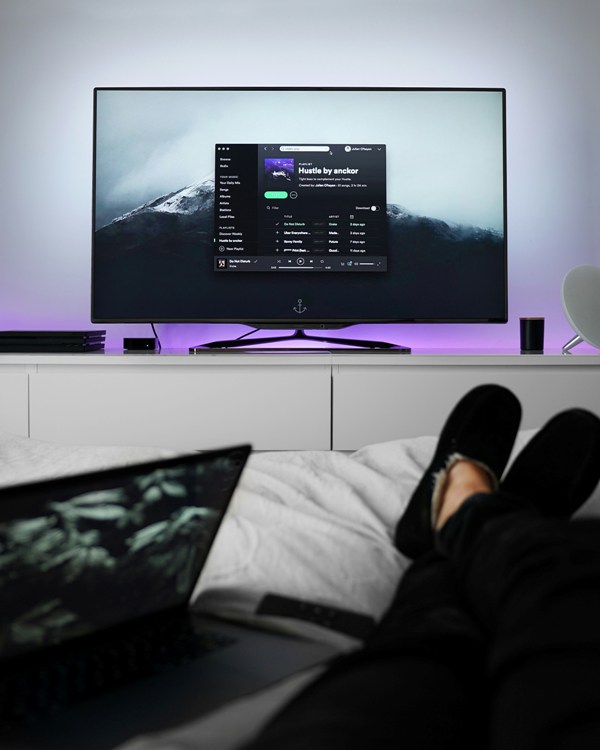
It is common to watch a show or keep a laptop open in the last hour of the day. Whether that keeps you up depends on the light, how alert the content leaves you, and how late you keep watching. If you already use one of our sleeping pods, the same habits apply once the programme is over.
Why screens and content can affect sleep
Light is one of the main cues for the body clock. The National Institute of Neurological Disorders and Stroke explains that cells in the brain receive information about light from the eyes and help set the daily sleep-wake cycle, and that the hormone melatonin helps you feel sleepy once it gets dark. The National Heart, Lung, and Blood Institute also notes that these clocks are regulated by light, darkness and sleep schedules.
Evening light from phones, tablets and televisions can delay that wind-down. The Sleep Foundation's overview of screens and sleep describes how short-wavelength light from back-lit devices may suppress melatonin and increase alertness when you are trying to settle.
Content matters as well. A tense plot, a stressful news bulletin or a work email can leave your mind switched on even in a dim room. The Sleep Foundation notes that stimulating content such as social media, games or work email may make it harder to relax before bed.
Timing and duration matter too, and here the evidence is mixed. A 2024 systematic review and meta-analysis of electronic media use and sleep quality found an association between more media use and poorer sleep. Most of the studies were correlational, so they cannot prove that screens alone caused the change, and the size of the link varied.
A smaller 2022 study that combined media diaries with EEG recordings in 58 adults found a more complicated picture. Using media in the hour before sleep was associated with an earlier bedtime, but longer sessions were associated with a later bedtime and less total sleep. The share of deep sleep and REM sleep did not clearly change. The authors cautioned that bedtime media use might not be as harmful as some earlier research suggested, and that session length matters. It was a small sample, so it should not be treated as the last word. An open copy of the paper is available from the University of Delaware.
Calmer shows versus more stimulating ones
There is no reliable evidence that one television genre is always best, or always worst, for everyone's sleep. People vary, and most studies group many kinds of screen use together. A useful test is simpler than a genre ranking: if the programme leaves you tense, angry, scared or eager to start the next episode, it is a poor choice close to bedtime. Calmer options tend to be familiar and easy to pause, such as a nature documentary you have already seen. Horror, tightly plotted action and late news are not “bad,” but they ask your brain to stay engaged when you are trying to settle.
Binge-watching is often a timing problem as much as a content problem. One more episode is how a short wind-down becomes a late night, and that late finish is the pattern the 2022 diary-and-EEG study linked with less total sleep. If you like a series, decide in advance which episode is the last one, or choose a show you already know so it is easier to stop.
Practical ways to wind down
A few habits help more than any particular programme:
- Give yourself a wind-down window. The Sleep Foundation suggests reducing screen time in the hour before bed. Use that time to wash up, dim the room and do something quieter.
- Lower the brightness. Turn down the television and the phone, use night mode if you have it, and avoid sitting close to a very bright screen in an otherwise dark room.
- Watch, then go to bed. If you can, finish the show in a chair or another room and walk into the bedroom already winding down, especially if you use a sleeping pod in your bedroom.
- Keep a cutoff you can repeat. The same rule helps on a work night in a workplace rest room, or when you are planning sleeping pods for an airport terminal: a short, planned episode is easier to contain than an open-ended queue.
- Get help if sleep problems last. This article is general information, not medical advice. If poor sleep continues, talk with a clinician. For a plain overview of sleep stages, see the NIH pages below and our notes on deep sleep and REM sleep.
How a dark, quiet, ventilated sleep pod can help
Once the show is over, the room you sleep in still matters. Darkness supports the same body clock that evening light can delay. Quiet helps when a household, an office or a shared building is still noisy. Fresh air matters if you have closed the door.
That is the idea behind our soundproof sleeping pods, also called sleep pods: an enclosed, ventilated cabin with a bed-sized space of your own. A sleep pod will not undo a late, overstimulating episode, and we do not claim it has been tested as a treatment for screen use. It can, however, give you a darker, quieter place to lie down once you have stopped watching.
If you are comparing an enclosed cabin with a nap chair or a temperature-controlled mattress, read our comparison of a sleep pod, Eight Sleep and a nap pod. For sizes, soundproofing and questions to ask before you buy, use the sleeping pod buyer's guide. We list sleeping pod prices for the single and double versions, and we ship to the USA and Canada, including major US cities. Common questions are in the FAQ. For a quote or a question about a space, contact The Sleeping Pods. More articles live on our Resources page.
Related reading
- Soundproof sleeping pods from The Sleeping Pods
- Sleeping pod pricing
- Sleeping pod buyer's guide
- Sleeping pods for your bedroom
- Sleeping pods for offices
- Sleeping pods for airports
- How our sleep pod compares to Eight Sleep and other nap pods
- Sleeping pods shipped to major US cities
- Sleeping pod FAQ
- All sleeping pod resources and articles
- Contact us about a sleeping pod
Sources
- National Institute of Neurological Disorders and Stroke, Brain Basics: Understanding Sleep
- National Heart, Lung, and Blood Institute, How Sleep Works
- Sleep Foundation, How Does Blue Light From Electronic Devices Affect Sleep?
- Han, X., Zhou, E., & Liu, D. (2024). Electronic media use and sleep quality: updated systematic review and meta-analysis. Journal of Medical Internet Research. Open full text on PMC (doi: 10.2196/48356).
- Ellithorpe, M. E., Ulusoy, E., Eden, A., Hahn, L., Yang, C.-L., & Tucker, R. M. (2022). The complicated impact of media use before bed on sleep. Journal of Sleep Research. Open author manuscript (doi: 10.1111/jsr.13551).
- Deep Sleep: What It Does and What Happens When You Get Too Little or Too Much, on Healing Sleep – Better Sleep for a Longer Life
- REM Sleep: What Happens When You Get Too Little, Too Much, or the Wrong Kind?